
Decoding Your Check Engine Light: Why a Generic Scanner Isn’t Enough for Your BMW
A check engine light is designed to get your attention. It does not, however, tell you exactly what has failed.
A basic OBD-II scanner may display a fault code in seconds. That information can be useful, but it is only the starting point. Modern BMWs and other European vehicles rely on interconnected control modules, vehicle-specific software, sensor data, and learned adaptations that a generic scanner often cannot access or interpret.
The difference matters. Reading a code is not the same as diagnosing the cause.
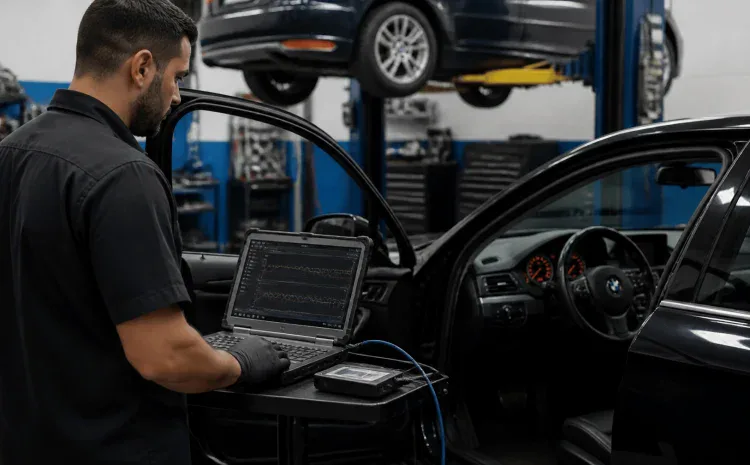
At Meisterwerks, our ASE-certified technicians use manufacturer-informed procedures and factory-grade diagnostic equipment to identify the underlying problem accurately. If you need BMW repair in Hallandale Beach, the right diagnostic process helps protect your vehicle from unnecessary parts replacement and repeated visits.
Why Your BMW’s Check Engine Light Causes So Much Concern
The check engine light can be triggered by hundreds of conditions. Owners often hear that there may be more than 400 possible triggers, depending on the vehicle’s systems, model year, and emissions configuration.
Possible causes include:
- A loose or damaged fuel cap
- An engine misfire
- A vacuum or intake leak
- A failing oxygen sensor
- Fuel pressure problems
- Turbocharger control faults
- VANOS or variable valve timing issues
- Catalytic converter efficiency concerns
- Ignition coil or spark plug problems
- Wiring, sensor, or control-module faults
These possibilities range from simple to serious. A loose gas cap may require a quick correction, while a flashing light accompanied by rough running can indicate an active misfire that may damage the catalytic converter.
That range is why the code alone cannot provide a complete answer. The vehicle’s operating conditions, symptoms, maintenance history, and supporting data must all be considered.
A Code Is a Clue, Not a Diagnosis
Read the Fault Code
A generic scan tool typically communicates with the engine computer through the standardized OBD-II emissions interface. It may display a code such as a P0300-series misfire code or an oxygen-sensor-related code.
This tells you which system detected an abnormal condition. It does not necessarily identify the failed component.
For example, an oxygen sensor code may be caused by the sensor itself, an exhaust leak, an intake leak, a fuel mixture problem, or an issue with the wiring. Replacing the sensor without testing the surrounding system can solve nothing.
Interpret the Code in Context
Professional diagnosis adds context to the code. Our technicians begin with the manufacturer’s technical specifications and work from there.
That process may include:
- Reviewing freeze-frame data
- Comparing commanded values with actual values
- Monitoring fuel trims and oxygen sensor activity
- Checking engine load, temperature, and RPM
- Graphing live data during a road test
- Testing wiring, connectors, and power supplies
- Comparing sensor plausibility across related systems
- Checking for technical service information relevant to the vehicle
Freeze-frame data is particularly useful because it records selected operating conditions when the fault occurred. Engine speed, coolant temperature, calculated load, fuel trims, and other values can help establish whether the problem appeared during a cold start, acceleration, cruising, or another condition.
The result is a more complete picture of what the vehicle was doing when the fault set.
Why the Same Code Can Mean Different Things
BMW systems change across model years, engine families, software versions, and vehicle platforms. The same general code description may therefore point to different diagnostic paths on different vehicles.
A turbocharged four-cylinder BMW does not use the same strategy as a naturally aspirated six-cylinder model. A newer vehicle may also have more sophisticated monitoring, additional sensors, and different control logic than an older model.
The code must be evaluated against:
- The vehicle identification number
- Model year and engine type
- Current software version
- Vehicle mileage and service history
- Related fault codes
- Driver symptoms
- Live operating data
- Manufacturer specifications
A scanner that simply translates a fault code into “replace component” is not accounting for those differences. Vehicle-specific diagnostics are essential for accurate luxury car maintenance in Florida, where BMW owners expect precise service rather than guesswork.
What a Generic Scanner Can and Cannot Do
A basic scanner has a legitimate purpose. It can often read standard powertrain codes, display limited live data, show freeze-frame information, and clear a warning after a repair.
That can be enough for a simple emissions-related issue. It is not enough for every BMW diagnostic concern.
Limited Module Communication
Modern BMWs contain multiple control units that communicate across the vehicle’s networks. These may include modules for:
- Engine management
- Transmission control
- ABS and dynamic stability control
- Airbag and supplemental restraint systems
- Steering
- Battery and charging management
- Climate control
- Body electronics
- Instrumentation
Many generic scanners focus primarily on the engine and emissions systems. They may not communicate fully with other modules or display manufacturer-specific faults stored outside the standard OBD-II system.
If your BMW has multiple warning lights, a no-start condition, electrical symptoms, or intermittent drivability problems, a partial scan can leave important information undiscovered.
Incomplete Live Data
Generic tools may display basic parameters such as RPM, coolant temperature, throttle position, and fuel trims. BMW-specific diagnostic software can provide much deeper information.
Depending on the vehicle, that may include:
- Turbocharger boost target versus actual pressure
- VANOS or camshaft timing values
- Fuel rail pressure
- Injector correction values
- Ignition timing
- Air-mass measurements
- Throttle and valve positions
- Transmission temperatures
- Battery state of charge
- Adaptation values
- Sensor plausibility checks
These readings allow a technician to test how systems behave instead of relying only on the name of a stored fault.
No Complete Guided Testing
Factory-grade equipment can support guided test plans and component activation. A technician may be able to command a pump, solenoid, valve, or actuator to operate and then verify whether the expected response occurs.
This is different from replacing a part because its circuit or sensor value produced a code. Testing confirms whether the component, wiring, control signal, and mechanical system are functioning together.

How Meisterwerks Approaches BMW Diagnostics
At Meisterwerks, we use a structured process designed to identify the cause before recommending a repair.
Start With Manufacturer Specifications
We begin by identifying the vehicle and reviewing the manufacturer’s technical requirements. This establishes the correct operating ranges, testing procedures, and diagnostic direction for that specific BMW.
We do not assume that every vehicle with the same code needs the same repair.
Scan the Vehicle’s Relevant Modules
Our factory-grade diagnostic process can access more than the basic engine interface. We review relevant control modules, stored faults, pending faults, and supporting information.
This is important when a check engine light appears alongside transmission, ABS, charging, or other warning messages.
Evaluate Live Data and Freeze Frames
We review the conditions surrounding the fault and analyze live data while the engine operates. Graphing data can reveal a sensor that is slow to respond, a pressure value that fails under load, or a command that does not match the system’s actual response.
These details help separate the failed component from the systems affected by it.
Perform Physical and Electrical Testing
Electronic information must be verified with hands-on testing. Our technicians inspect connectors, wiring, vacuum lines, intake components, grounds, fluids, and mechanical systems as required.
This prevents a software diagnosis from becoming a parts-swapping exercise.
Document the Findings Clearly
We provide transparent communication and detailed documentation so you understand what was found, what testing was performed, and which repair is recommended.
Our approach is designed to restore dependable performance while helping you make an informed decision about your vehicle.
What to Do When Your Check Engine Light Comes On
Check the Fuel Cap
If the light appears shortly after refueling, make sure the fuel cap is installed correctly and tightened. A loose or damaged cap can allow fuel vapor to escape and may trigger an emissions fault.
The light may not turn off immediately. The vehicle may need several drive cycles before the system confirms that the condition is resolved.
Notice Whether the Light Is Steady or Flashing
A steady check engine light generally indicates that the vehicle has detected a fault that requires attention but may still be driveable.
A flashing light is more urgent. It can indicate an active misfire or another condition that may cause additional damage. Reduce driving and arrange professional inspection as soon as possible.
Pay Attention to Symptoms
Record what you notice when the light appears:
- Rough idle
- Loss of power
- Poor acceleration
- Hard starting
- Unusual noises
- Increased fuel consumption
- Smoke or unusual odors
- Additional dashboard warnings
Also note whether the light appeared during startup, acceleration, highway driving, or after refueling. This information can help your technician reproduce the concern.
Do Not Clear the Code Before Diagnosis
Clearing a fault may turn the light off temporarily, but it also removes useful information. It can erase freeze-frame data and reset emissions monitors, making the next diagnostic step more difficult.
If you use a parts-store scanner, save or photograph the code and bring the information to a qualified shop. Do not treat the code description as a final diagnosis.
When to Schedule European Auto Repair in Hallandale Beach
You should arrange an inspection if the check engine light remains on, returns after clearing, or appears with noticeable performance changes. Prompt diagnosis is especially important when the vehicle has reduced power, severe vibration, overheating, fuel odors, or multiple warning lights.
Meisterwerks provides European auto repair in Hallandale Beach for BMW, Mercedes-Benz, Audi, Porsche, and other European vehicles. Our team also services Asian and domestic vehicles, using professional diagnostic procedures appropriate to the vehicle.
We combine ASE-certified expertise, advanced equipment, detailed documentation, and transparent recommendations. Approved repairs are backed by our 2-Year/24k-Mile warranty, giving you additional protection after service.
Accurate Diagnostics Protect Your BMW
A generic scanner can tell you that a fault was detected. Factory-grade diagnostics help explain why it was detected and what should be tested next.
That distinction can prevent unnecessary parts replacement, reduce repeat repairs, and help restore the performance and reliability expected from a BMW. If your check engine light is on, schedule diagnostics at Meisterwerks or contact our Hallandale Beach shop.
For professional BMW repair in Hallandale Beach, visit Meisterwerks at 200 N Federal Hwy or call (954) 999-4080. Book an appointment today.